Thoughts on AI Productivity Gains and Fewer Entry-Level Jobs
AI gives junior workers the biggest productivity boost, yet entry-level hiring in AI-exposed jobs is falling. How both can be true, and why the experience pipeline is the real risk.
This post started as my Week 6 reflection for a Stanford course on AI. The prompt asked:
Less-experienced workers often received the largest immediate productivity boost from AI. At the same time, employment declined among the youngest workers in some AI-exposed occupations. How can both findings be true?
I went back to the two studies behind the prompt to check whether the data supports my original answer. For the most part it does, and it also made the long-term risk clearer to me.
Productivity per worker is not demand for workers
Both findings can be true at the same time because productivity per worker and demand for workers are two different outcomes. AI can make less-experienced workers more productive while at the same time reducing the total number of workers a company needs.
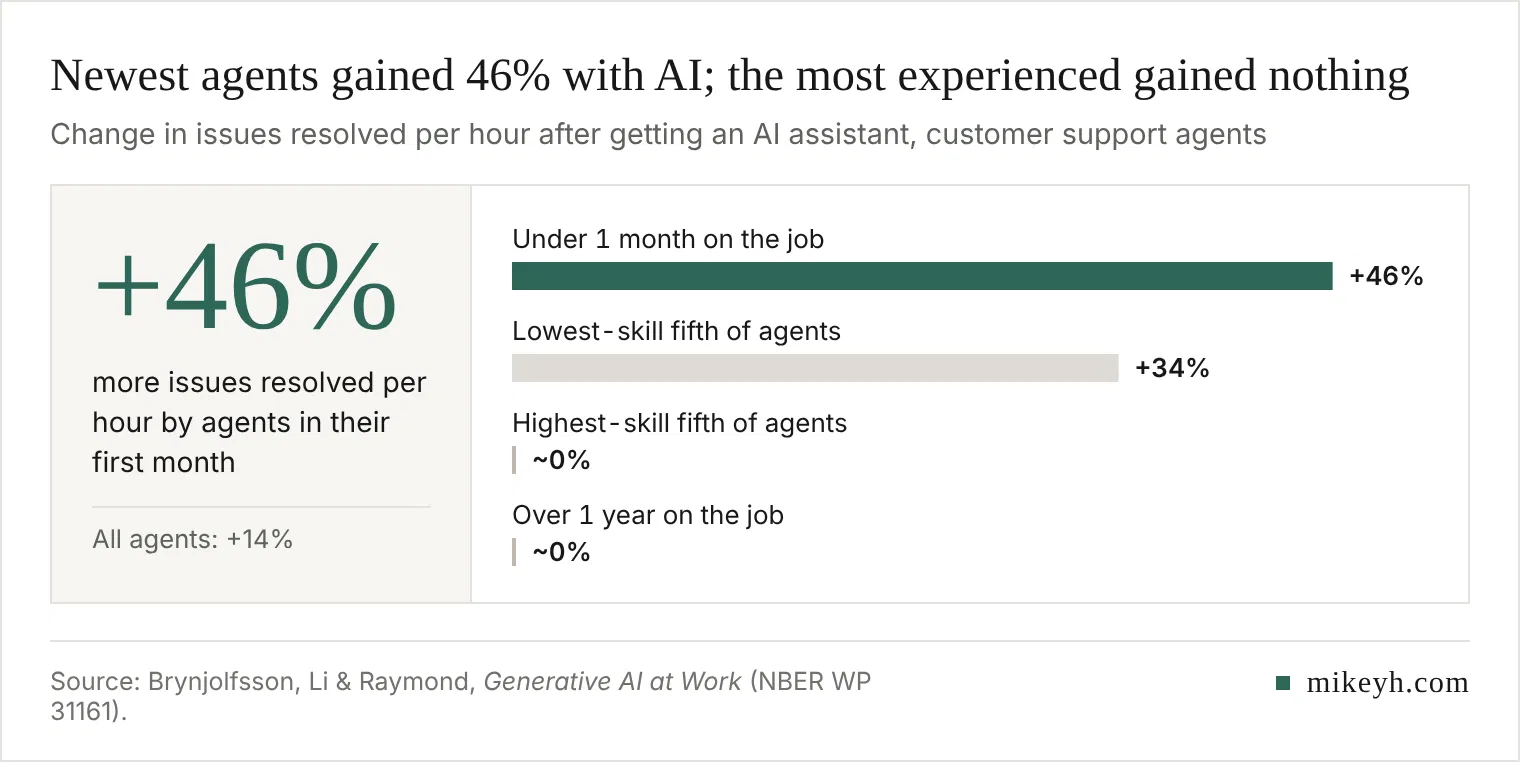
The two findings come from two Stanford-led studies. In Generative AI at Work, Brynjolfsson, Li and Raymond studied 5,179 customer support agents and found that AI assistance raised productivity 14% on average and 34% for the lowest-skilled agents. In Canaries in the Coal Mine, Brynjolfsson, Chandar and Chen used payroll data covering millions of U.S. workers and found that employment of 22–25-year-olds in the most AI-exposed jobs fell about 11% from November 2022 to June 2026, while the same age group in less-exposed jobs grew about 10%. That is a 21-point gap, which leaves young workers in exposed jobs about 19% below where they would be if they had kept pace with the same age group in less-exposed jobs.
Why juniors gain the most
Less-experienced workers receive the largest productivity boost because they begin with a wider gap between their current skills and what the job requires. Much of junior work involves simpler tasks that AI can now assist with or handle outright, including researching new topics, writing intermediate-level code, drafting documents, and automating manual work. In the support study, agents with two months on the job and AI performed as well as agents with more than six months and no AI. Senior members gain a smaller lift, since much of their time goes to QA and to work that juniors could not produce in the first place. For the most skilled agents, some quality measures even slipped slightly.
I see the same thing in analytics. Writing a SQL query or building a recurring report is only part of the job. The harder part is knowing whether the underlying data is reliable, what a metric represents, which edge cases matter, and whether the analysis answers the business question. AI can now handle much of the first part, but the second part still depends on experience.
Why higher productivity can mean fewer openings
That same effect changes the economics of hiring. Businesses generally make hiring decisions on three things: productivity, budget, and long-term development. Hiring less-experienced workers has historically offered all three: simpler tasks completed, a lower salary cost, and an opportunity to develop talent for a better long-term return. But if the problems a company is solving stay the same and each worker produces more with AI, the company may need fewer junior workers to reach the same level of output. In many cases, the junior tasks themselves are replaced by AI.
Higher productivity can also lead to more hiring. A company could use the extra capacity to build more products, serve more customers, or take on work that was not worth doing before. Whether it ends up hiring fewer people depends on whether demand for its output grows as fast as productivity. If it does not, the company has less reason to add headcount, especially at the entry level.
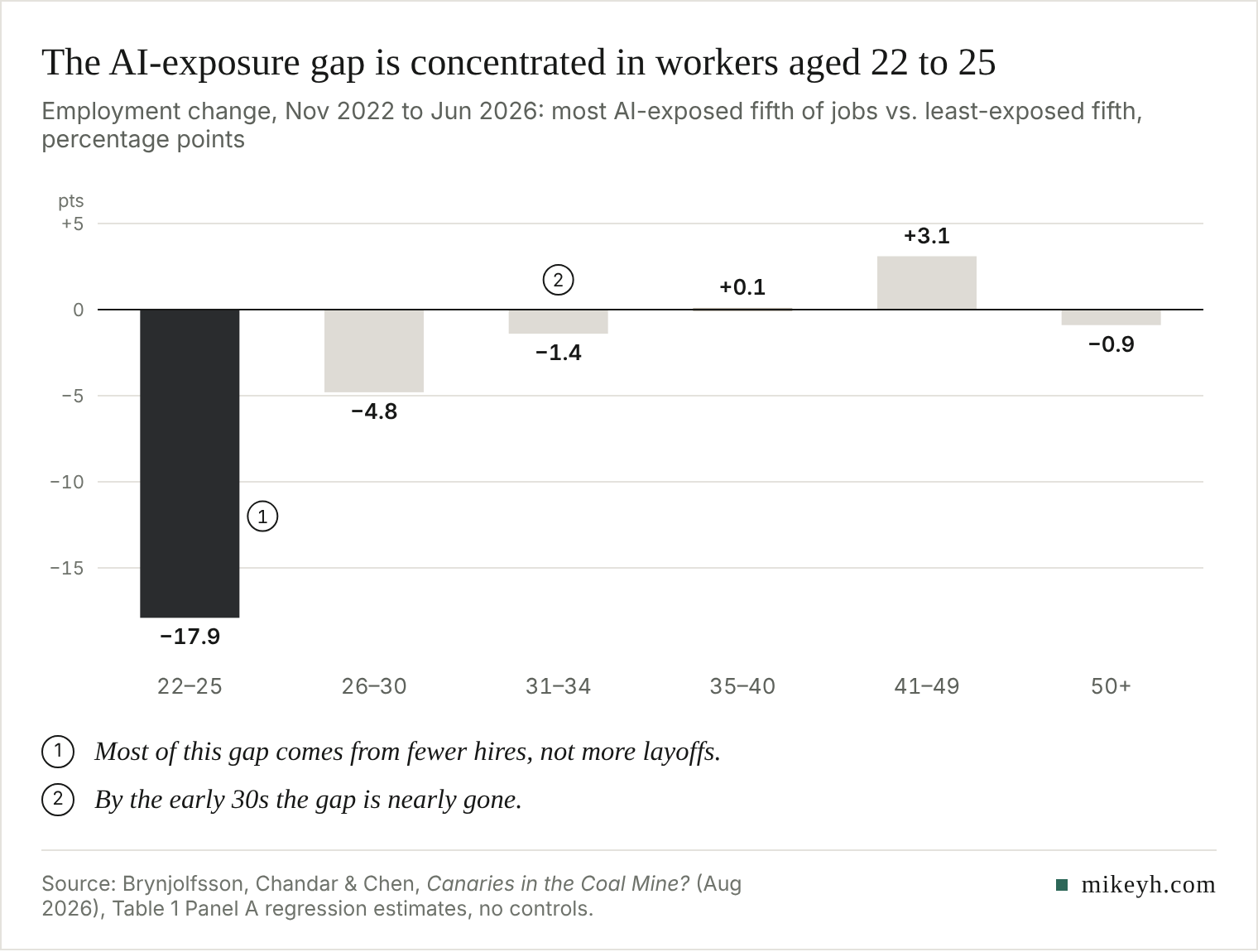
The payroll data fits this picture. The chart compares only the most-exposed fifth of jobs with the least-exposed fifth, so its figure for ages 22–25 (about 18 points) is a little smaller than the 21-point gap above. The gap shows up almost entirely at ages 22–25 and fades by the early 30s. It comes mainly from fewer hires rather than more layoffs, and it is concentrated in jobs where AI is used to automate tasks. The authors call these descriptive facts rather than proof that AI caused them, since the gap roughly halves after controlling for education and some of it started before ChatGPT. AI is likely one of several factors behind the change in hiring.
Experience-biased retention
The limitation of AI models is that they lack specificity in certain domains and company knowledge. Because of this limitation, AI systems still require a high level of orchestration, guidance, and QA to produce accurate work. Experienced employees are generally better positioned to decide which problem to solve, evaluate whether the AI-generated result is credible, and communicate the final recommendation. This creates an experience-biased form of retention, where companies allocate more of their budget to keeping or hiring experienced workers than to entry-level workers. An experienced worker with AI can now cover work that used to need support from several junior employees.
The payroll data points the same way. In jobs where AI is mostly used to complement people rather than automate their tasks, employment is flat or rising, especially for experienced workers. For any given role, what matters is whether AI replaces the work or makes the person doing it more valuable.
Uncertainty makes waiting look safer
The current pace of AI development also introduces uncertainty for many companies and delays hiring. Every other week we see a frontier model perform another complex task or solve a new problem, or a new AI startup introduce a product that disrupts existing working models and businesses. In addition, the public market is rewarding companies that adopt AI strategies, leading many companies to scramble to allocate budget in that area first. Because hiring a junior employee is a multi-year investment, when companies are uncertain about their immediate business, what technology will be available, and what tasks will need to be solved in the next few years, waiting may appear safer than expanding the entry-level workforce today. The two studies do not measure this directly, so this part is my own read of what is happening.
What younger workers can do
Younger workers may still develop an advantage by becoming more AI-native. But their value will not come merely from writing prompts faster. They will need to demonstrate that they can evaluate AI output, design reliable workflows, work with incomplete information, develop domain expertise, and take responsibility for the result. AI also lets less-experienced workers take on work that used to require more experience, but that is harder to show when there are fewer entry-level roles to start in.
The real risk: the experience pipeline
In the near term, AI may weaken traditional entry-level jobs by reducing demand for routine junior work. Over time, new pathways may emerge as AI's capabilities and gaps become more clearly defined. However, this would require both workers to adapt and build non-traditional skill sets, and companies, educational systems, and government to create the opportunities for the workforce.
The deeper long-term problem is the experience pipeline. Companies still need experienced people to supervise AI, make decisions, and handle cases that don't fit existing workflows, but experienced workers are created through years of junior-level practice. If businesses remove too many entry-level opportunities today, they may eventually struggle to develop the judgment and institutional knowledge that AI systems still depend on.
Sources
- Brynjolfsson, Li & Raymond. Generative AI at Work. NBER Working Paper 31161 (2023; published in the Quarterly Journal of Economics, 2025).
- Brynjolfsson, Chandar & Chen. Canaries in the Coal Mine? Six Facts about the Recent Employment Effects of Artificial Intelligence. Stanford Digital Economy Lab, revised August 2026.
- Stanford Digital Economy Lab. No Widespread Displacement, but the AI Employment Gap for Young Workers Has Widened to 19%. August 2026.